

What’s the Difference?
Racket sports have grown rapidly in popularity around the world, especially in the Middle East and Europe. Many people often confuse the terms padel court and paddle tennis court, assuming they refer to the same thing. However, these are actually two different sports with different rules, equipment, and court designs.
Understanding the difference between paddle tennis and padel can help players choose the right sport and court for their playing style. Both sports use paddles instead of traditional rackets and are played on smaller courts compared to tennis, but their gameplay experience is quite different.
In this guide, we will explain everything you need to know about a paddle tennis court, how it compares to a padel tennis court, and why padel has become one of the fastest-growing sports worldwide.
What is a Paddle Tennis Court?
A paddle tennis court is designed for the sport known as paddle tennis. This sport was created in the United States as a simplified version of tennis that can be played on a smaller court.
Unlike a padel court, a paddle tennis court does not have glass walls surrounding it. The ball must stay inside the court boundaries, and players cannot use walls as part of the gameplay.
Key Features of a Paddle Tennis Court
- Smaller than a standard tennis court
- No glass walls or enclosures
- Uses solid paddles instead of string rackets
- Played with a depressurized tennis ball
- Usually played outdoors
The game focuses mainly on quick reactions, volleys, and placement, making it fast-paced and competitive.
Paddle Tennis Court Dimensions
The standard dimensions of a paddle tennis court are approximately:
- 50 feet long
- 20 feet wide
The court is divided by a net similar to a tennis net but is significantly smaller in size.
Because the court is open and has no walls, the gameplay feels similar to mini tennis but with paddles instead of rackets.
What is a Padel Court?
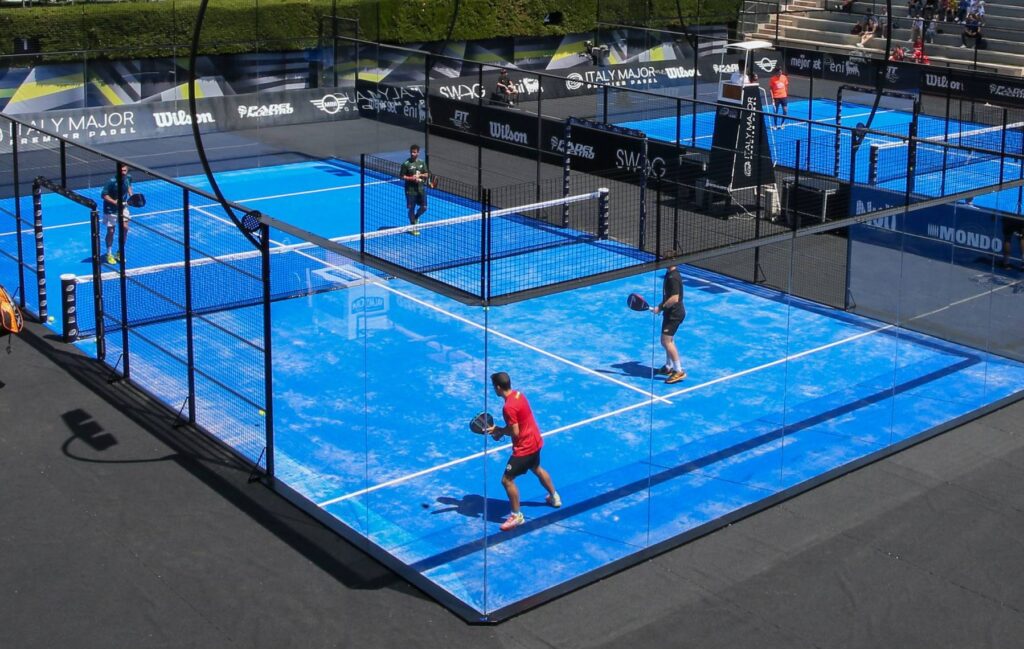
A padel court, often referred to as a padel tennis court, is specifically built for the sport of padel. Padel originated in Mexico and became extremely popular in Spain before spreading worldwide.
Unlike a paddle tennis court, a padel court is enclosed by glass walls and metal fencing, and these walls are an important part of the game. Players can hit the ball against the walls, which adds strategy and longer rallies.
If you are unsure, FM Padel Academy coaches can guide you in selecting the right option.
Key Features of a Padel Court
A padel tennis court typically includes:
- Glass walls surrounding the court
- Metal fencing on the sides and back
- Artificial turf surface
- Lower net compared to tennis
- Designed primarily for doubles play
The walls allow the ball to rebound during rallies, which makes padel more strategic and dynamic than paddle tennis.
Difference Between Paddle Tennis and Padel
Although the two sports sound similar, there are several major differences between a paddle tennis court and a padel court.
Court Design
The biggest difference between paddle tennis and padel is the court structure.
A paddle tennis court is open and does not include surrounding walls. The ball must remain inside the playing area.
A padel court, however, is completely enclosed with glass walls and fencing, allowing players to use rebounds during play.
This enclosure changes the entire dynamic of the game and creates a more strategic playing style.
Court Size
Padel courts are larger than paddle tennis courts.
Padel Court Dimensions
- 20 metres long
- 10 metres wide
Paddle Tennis Court Dimensions
- 50 feet long
- 20 feet wide
The larger court size and wall rebounds allow for longer rallies in padel.
Gameplay Style
The gameplay experience between the two sports is very different.
Paddle Tennis Gameplay
- Faster points
- Direct shots
- No wall rebounds
- Strategic rallies
- Use of walls
- Longer and more tactical matches
Padel often feels like a combination of tennis and squash, making it exciting for both beginners and experienced players.
Equipment
Both sports use paddles, but the equipment is slightly different.
Paddle Tennis Equipment
- Solid paddle
- Slightly heavier
- Standard or depressurized tennis ball
Padel Equipment
- Perforated padel racket
- Lightweight design
- Low-pressure tennis ball
Padel rackets are designed for control and maneuverability, which helps players manage rebounds off the glass walls.
Popularity Worldwide
Another key difference between paddle tennis and padel is global popularity.
Paddle tennis is mainly popular in the United States, while padel has become one of the fastest-growing sports in the world.
Padel has seen huge growth in:
- Spain
- Italy
- Sweden
- UAE
- Latin America
In cities like Dubai, padel courts are rapidly expanding due to increasing demand from sports enthusiasts.
Why Padel Courts Are Growing So Fast
The popularity of padel courts has grown dramatically over the past decade. Many clubs and academies are investing in padel tennis courts because the sport is easy to learn and very social.
Easy for Beginners
Padel is easier to pick up compared to traditional tennis. The smaller court and wall rebounds make it easier to keep the ball in play.
Social and Fun
Padel is usually played in doubles, which makes it a great activity for friends, families, and colleagues.
Great Workout
Padel provides excellent cardiovascular exercise while still being enjoyable and accessible for players of all fitness levels.
FM Padel Academy Locations Across the UAE
If you are looking for a professional padel court in the UAE, FM Padel Academy provides multiple locations where players can train and enjoy the sport.
Padel Courts in Dubai
Dubai has become one of the leading cities for padel in the Middle East. FM Padel Academy offers several locations across the city.
Our Dubai locations include:
- FM Padel Academy – King School
- German International School Dubai
- Brighton College Dubai
- FM Padel Academy – Al Quoz
- PLAYCE
These courts offer excellent facilities for players looking to enjoy the sport or improve their skills.
Padel Courts in Abu Dhabi
Players in Abu Dhabi can also access high-quality courts through FM Padel Academy partner locations.
Available locations include:
- Padelist – Al Rawadhat
- Emirates Padel
- Padelae Abu Dhabi – Musaffah
These venues provide modern padel tennis courts designed for professional gameplay.
Padel Court in Sharjah
Players in Sharjah can enjoy padel at:
- Sheraton Sharjah Beach Resort & Spa
This location offers a premium playing experience combined with world-class hospitality facilities.
Book Your Padel Session
If you want to experience the excitement of playing on a professional padel court, FM Padel Academy offers some of the best padel tennis courts in Dubai and across the UAE.
Whether you are a beginner learning the basics or an experienced player looking for competitive matches, our courts provide the perfect environment to enjoy the sport.
Our facilities are designed to deliver high-quality playing conditions, coaching programs, and a welcoming community for all players.
Book your padel session here:
https://fmpadelacademy.ae/contact/#get-your-promo
Start playing today and discover why padel is one of the fastest-growing sports in the world.